
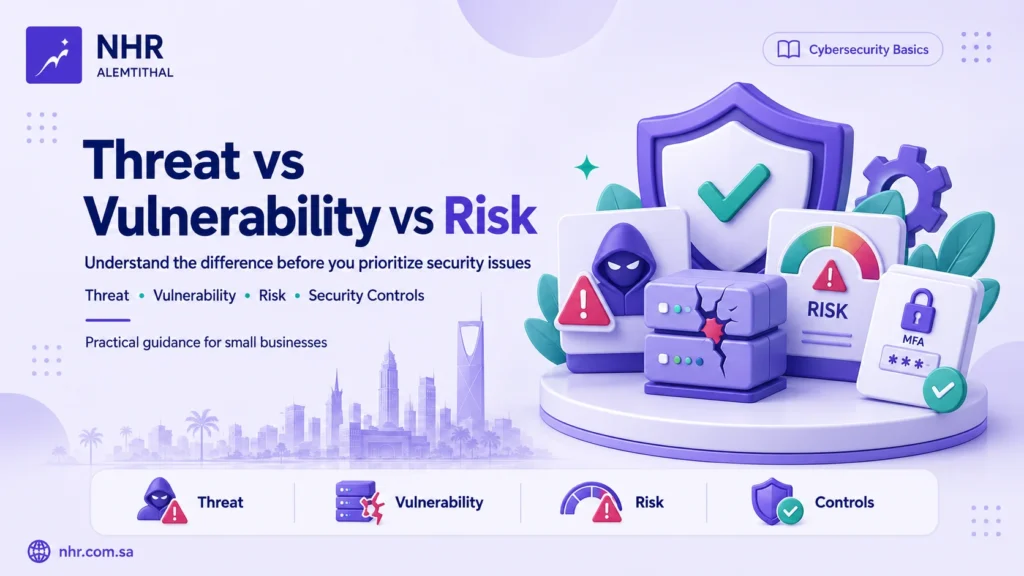
When a security report shows dozens of findings, the useful question is not simply, “How many vulnerabilities do we have?” A better question is: Which issues can realistically affect the business, and which should we address first?
That is where three basic cybersecurity concepts matter: threat, vulnerability, and risk.
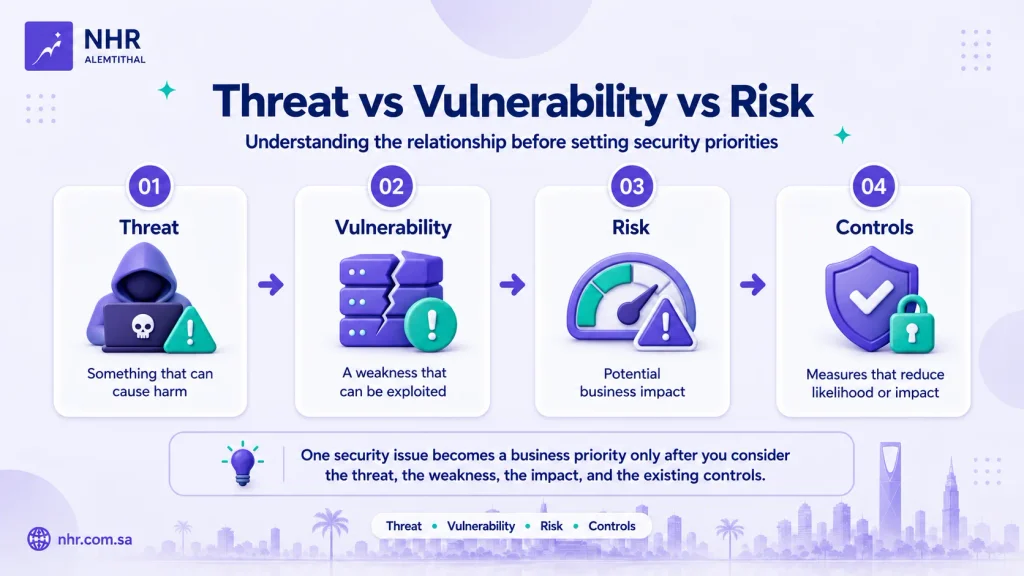
NIST describes a threat as a circumstance or event that can adversely affect operations or assets. A vulnerability is a weakness in a system, procedure, control, or implementation that can be exploited or triggered. Risk reflects the potential adverse impact on the organization.
In practical terms:
Threat: What could cause harm?
Vulnerability: What weakness could make that harm possible?
Risk: What could happen to the business, and how significant is the scenario?
Professional notice: This article is for awareness and education. It is not a cybersecurity risk assessment, security audit, or compliance determination for your organization.
Why Does the Difference Matter to a Small Business?
In a small organization, one IT administrator may handle Microsoft 365, endpoints, networking, backups, user accounts, and day-to-day support. Not every finding can receive the same priority.
Management also does not need a list of CVE numbers. It needs to know whether an issue could interrupt operations, expose information, enable unauthorized access, or create financial loss.
Threat asks what may cause harm. Vulnerability identifies the weakness. Risk considers what the scenario could mean for the business.
For Management
When IT reports a security issue, ask: Which asset is affected? What is the realistic scenario? What could it do to the business? What action will reduce the risk?
A Practical Example: Business Email Without MFA
Suppose an employee’s business email account is protected only by a password.
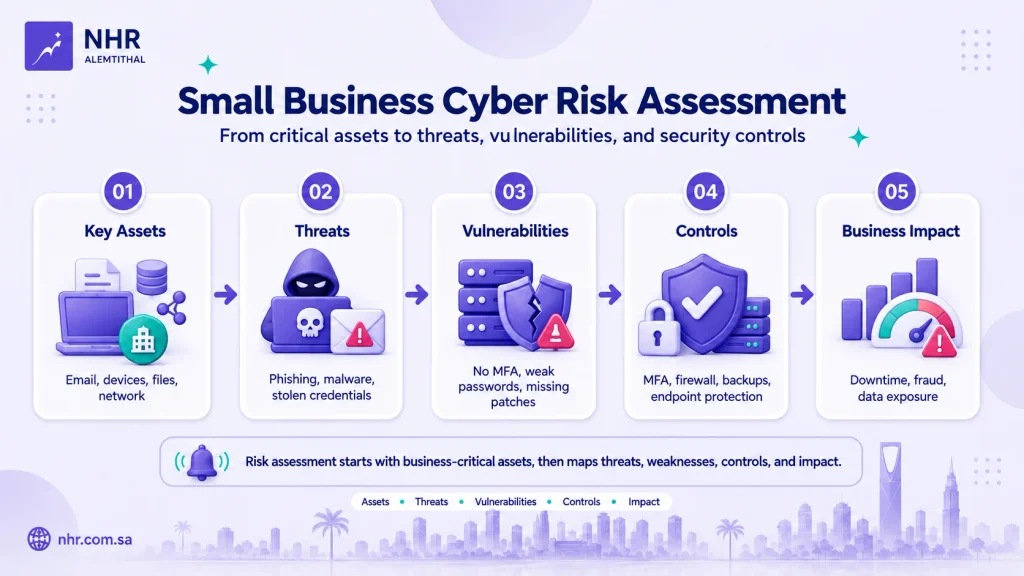
The vulnerability is the absence of multi-factor authentication. The threat could be an attacker who obtains the password through phishing or leaked credentials. The risk is the consequence if the attacker gains access: reading sensitive correspondence, impersonating the employee, sending fraudulent payment requests, or reaching connected services.
Enabling MFA, reviewing permissions, and monitoring unusual sign-ins do not remove attackers from the internet. They can reduce the likelihood or impact of a successful compromise.
That is the practical role of security controls: reduce risk rather than assume every threat can be eliminated.
Does a Critical Vulnerability Always Mean Critical Risk?
Not necessarily.
The same vulnerability might exist on an internet-facing production server and an isolated test device. Its technical severity may be similar, but the business context is different.
FIRST states that the CVSS Base Score measures vulnerability severity, not risk. Threat and environmental context should also be considered when prioritizing remediation.
Risk
A CVSS score is a technical input, not a business decision by itself. Consider the affected asset, exposure, relevant threats, existing controls, and potential business impact.
How Should a Small IT Team Prioritize Security Issues?
A practical sequence is:
Asset → Threat → Vulnerability → Existing Controls → Likelihood → Impact → Priority
Start with the systems the business genuinely depends on email, files, financial systems, administrative accounts, backups, and internet-facing services. Then map realistic threats, weaknesses, and controls around those assets.
Saudi Arabia’s National Cybersecurity Authority maintains the National Framework for Cybersecurity Risk Management as a national reference for managing cyber risk in the Kingdom.
The goal is not to build a complex GRC function. It is to move from:
“We have 100 findings.”
to:
“These are the issues most likely to affect our business, and this is how we plan to reduce them.”
How Can We Help at NHR Alemtithal?
For general awareness, we provide A Simplified Guide to Cybersecurity Basics for SMEs and employees. The resource is already published on the NHR website specifically for this audience.
For Saudi Aramco suppliers that are unsure where they stand against SACS-210, we also provide a free preliminary SACS-210 Self-Assessment covering the 33 General Requirements from TPC1.1 to TPC1.33. The report highlights potential gaps, associated risks, and high-level next steps based on the answers submitted.
Service Boundary
Our self-assessment is a preliminary readiness tool. It is not an official audit, CCC certificate, or guarantee of compliance. Formal verification and certificate issuance remain the responsibility of an Aramco-authorized audit firm.
Conclusion
The distinction is simple:
Threat: what could cause harm.
Vulnerability: the weakness that may allow it.
Risk: what that scenario could mean for the business.
For IT, this improves prioritization. For management, it turns cybersecurity from a technical findings list into clearer decisions about what to protect, what can threaten it, and what deserves attention first.
Do not start with the number of vulnerabilities. Start with the assets that matter to the business, then evaluate the threats, weaknesses, controls, likelihood, and impact around them.
Frequently Asked Questions
What is the difference between a threat and a vulnerability?
A threat is something that can cause harm. A vulnerability is a weakness that may allow that threat to succeed.
Does every vulnerability create high cybersecurity risk?
No. Risk depends on factors such as the affected asset, exposure, relevant threats, existing controls, likelihood, and business impact.
Should every Critical vulnerability be fixed first?
Not automatically. Technical severity matters, but the organization’s environment and business impact should also influence prioritization.
Is CVSS the same as a risk score?
No. FIRST states that the CVSS Base Score measures vulnerability severity and should not be used by itself to assess organizational risk.
What do security controls do to risk?
Controls such as MFA, patching, least privilege, backups, and monitoring can reduce the likelihood of a successful incident or limit its impact.
Can an organization eliminate every cyber threat?
Usually not. Effective cybersecurity focuses on reducing exposure and keeping risk at a level the organization can manage.
Who owns cybersecurity risk: IT or management?
IT usually manages many of the technical controls, but management must participate because business impact, priorities, resources, and risk decisions are organizational responsibilities.
Official References
Need help with Aramco CCC Certification?
Get a Free Expert Consultation.