For a small Saudi supplier, GRC does not need to mean a large compliance department, expensive GRC software or dozens of disconnected procedures.
In the context of SACS-210 General Requirements, GRC is a practical way to make sure your business can answer four simple questions:
- What does the requirement expect?
- What policy, procedure, checklist or technical control do we need?
- Has it actually been implemented?
- Can we show clear evidence when required?
That is the practical purpose of Governance, Risk and Compliance for a small Aramco supplier.
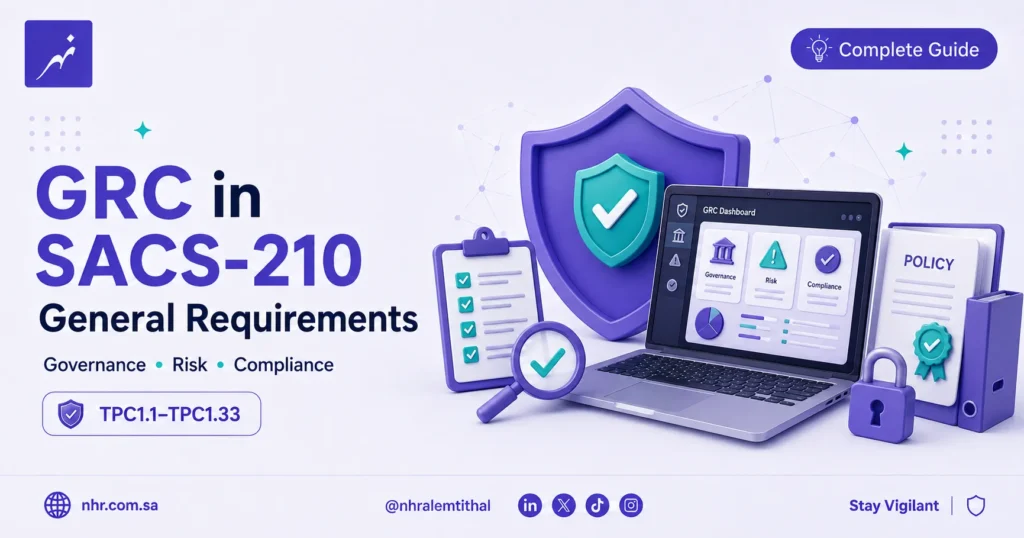
SACS-210 General Requirements cover TPC1.1 through TPC1.33. They include governance, asset management, access control, data security, email security, logging and incident response requirements.
This guide explains how a small supplier can organize those requirements without turning compliance into an enterprise-scale GRC program.
Quick Summary
For a small Saudi business, GRC can be understood simply:
Governance
Put the required policies, responsibilities and working rules in place.
Risk
Understand what security problem each requirement is intended to reduce.
Compliance
Implement what is required and retain enough documentation and evidence to demonstrate it.
A practical small-business model is:
SACS-210 Requirement → Practical Document or Checklist → Action → Evidence
You do not need a dedicated GRC department to use this model.
Your General Manager, IT administrator or MSP, HR/Admin staff and other responsible employees may each handle parts of the work.
The important point is that the required activity is documented, performed and retained in a way the business can demonstrate later.
What Does GRC Mean for SACS-210 General Requirements?
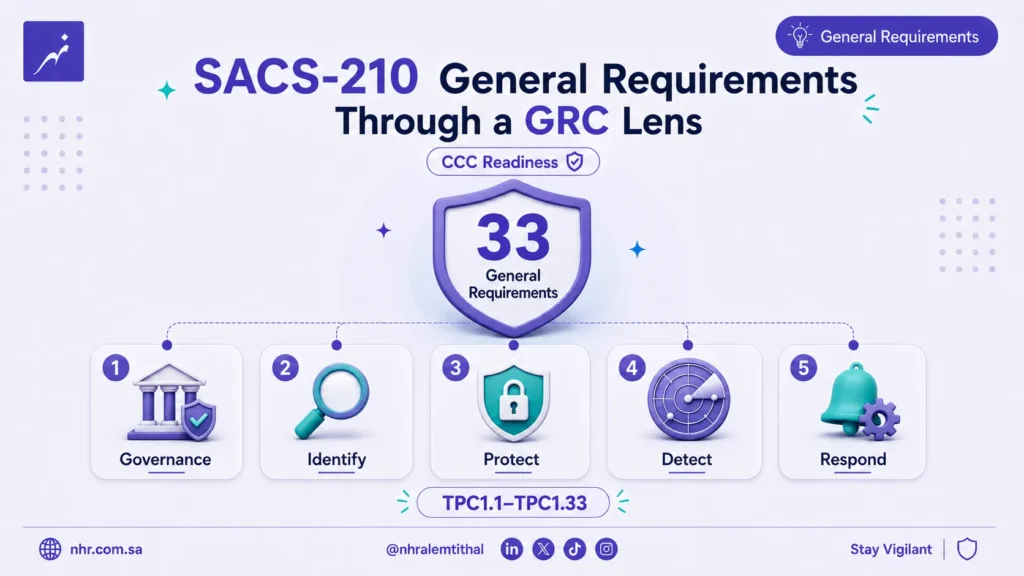
GRC stands for:
- Governance
- Risk
- Compliance
In this article, GRC is a management lens for understanding and organizing SACS-210 General Requirements.
It is not:
- a separate SACS-210 control family;
- another certificate;
- an additional Aramco classification;
- a requirement to purchase GRC software;
- or a requirement to create a large compliance department.
For a small supplier, the value of GRC is much more practical.
It helps connect a requirement to the document, operational activity or technical control needed to support it.
Example
SACS-210 TPC1.4 requires a formal documented employee onboarding and offboarding process.
A small business does not need a complicated enterprise workflow to make this usable.
A practical Employee Offboarding Checklist can guide the responsible person through tasks such as:
- collecting company laptops and other assets;
- removing email and system access;
- revoking remote-access permissions where applicable;
- confirming completion; and
- keeping the completed checklist as evidence.
The checklist is not meaningless paperwork. When properly customized and actually used, it can become an important part of the documented process.
The goal is not to produce more documents.
The goal is to have the right documents, used consistently in the real business environment.
Governance: Keep It Practical
Governance sounds complicated, but for a small supplier it starts with a much simpler question:
Do we have the policies, working rules and records needed to operate the requirement consistently?
Several SACS-210 General Requirements directly depend on documentation.
For example:
TPC1.2 requires the Third Party to develop, approve and communicate an Acceptable Use Policy.
A practical implementation may look like this:
Requirement: Acceptable Use Policy
Document: Customized AUP
Action: Approve and communicate it to employees
Evidence: Approved policy and acknowledgement or communication records
If you are starting from scratch, NHR Alemtithal provides a Free Acceptable Usage Policy Template that can provide a starting point.
A downloaded template is not compliance by itself.
It needs to be:
Customize → Approve → Communicate → Use
Cybersecurity Policies and Standards
TPC1.3 also requires cybersecurity policies and standards covering areas such as asset management, access management, physical security, secure disposal, data handling, incident management, vulnerability and patch management, and business continuity/disaster recovery.
For a small supplier, this should not automatically become a collection of unnecessarily complex enterprise documents.
The objective is to create a manageable documentation set that reflects the actual environment and how the business really works.
That distinction matters.
A five-person supplier should not be forced into pretending that it operates like a multinational organization.
Its documentation should still address the applicable requirements, but it should remain usable by the people who actually run the business.
Risk: What Problem Is the Requirement Reducing?
Within this guide, Risk does not mean that every small supplier must build an enterprise risk-management program just to understand the General Requirements.
Formal cybersecurity risk-management methodology appears within SACS-210 Specific Requirements and should not be incorrectly attributed to TPC1.1–TPC1.33.
For the General Requirements, a more useful small-business question is:
What cyber or operational risk is this requirement helping us reduce?
Examples:
| Requirement area | Practical risk being reduced |
|---|---|
| Unique user credentials | Loss of accountability and unauthorized account use |
| MFA | Account compromise |
| Access reviews | Former or unnecessary users retaining access |
| Asset inventory | Devices or systems becoming unmanaged or forgotten |
| Email authentication | Domain spoofing and impersonation |
| Anti-malware protection | Malware infection |
| Protected logs | Loss or manipulation of security evidence |
| Incident notification | Delayed response to a cybersecurity incident |
This makes GRC easier to understand.
You are not implementing MFA because a GRC spreadsheet says so.
You are implementing MFA because it reduces authentication and account-compromise risk while supporting the applicable SACS-210 requirement.
Compliance: Documents Must Be Used, Not Just Stored
One of the most common misunderstandings in compliance work is treating documentation as a filing exercise.
A policy that exists but is never followed has limited practical value.
At the same time, a small business that implements controls but keeps no documentation or records may struggle to demonstrate what it has done.
The practical balance is:
Document what must happen → Perform it → Keep evidence
Consider a few examples.
| SACS-210 area | Practical document or record | Operational or technical action | Possible evidence |
| Acceptable use | AUP | Approve and communicate the policy | Approved document and acknowledgements |
| Onboarding/offboarding | Checklist or form | Create/remove access and return assets | Completed checklist |
| Asset management | Asset register | Record and maintain technology assets | Current inventory |
| Access review | Access review record | Review accounts and permissions | Completed review report |
| Email security | Security configuration record | Configure required mail protections | Configuration evidence |
| Incident response | Incident procedure/form | Record, escalate and notify when required | Incident records and notifications |
This is much closer to how compliance works in a small organization than an enterprise GRC model with multiple specialist departments.
Documentation Can Save a Small Business Significant Work
Large organizations may have dedicated teams writing policies, maintaining registers and designing compliance workflows.
A small Saudi supplier often does not.
The same person may be handling operations, procurement, IT coordination and supplier requirements.
Starting every policy, form, register and checklist from a blank page can therefore consume significant time.
A structured documentation library can reduce that starting burden.
The SACS-210 Compliance Kit Guide explains how NHR Alemtithal’s documentation kit is structured for SACS-210 preparation.
The SACS-210 Compliance Kit provides 17 editable Word and Excel templates plus an implementation guide that can be adapted to the supplier’s environment.
The purpose is not to replace implementation.
It is to avoid rebuilding common compliance documents from zero.
A useful template can help a small business move more quickly from:
“We know we need a process.”
to:
“We have a practical document we can customize, approve and start using.”
The distinction is important:
Template + customization + actual use + evidence
is very different from:
Template = certification
Documentation supports the compliance effort. It does not replace technical controls, operational execution or formal verification.
A Simple GRC Model for Small Aramco Suppliers
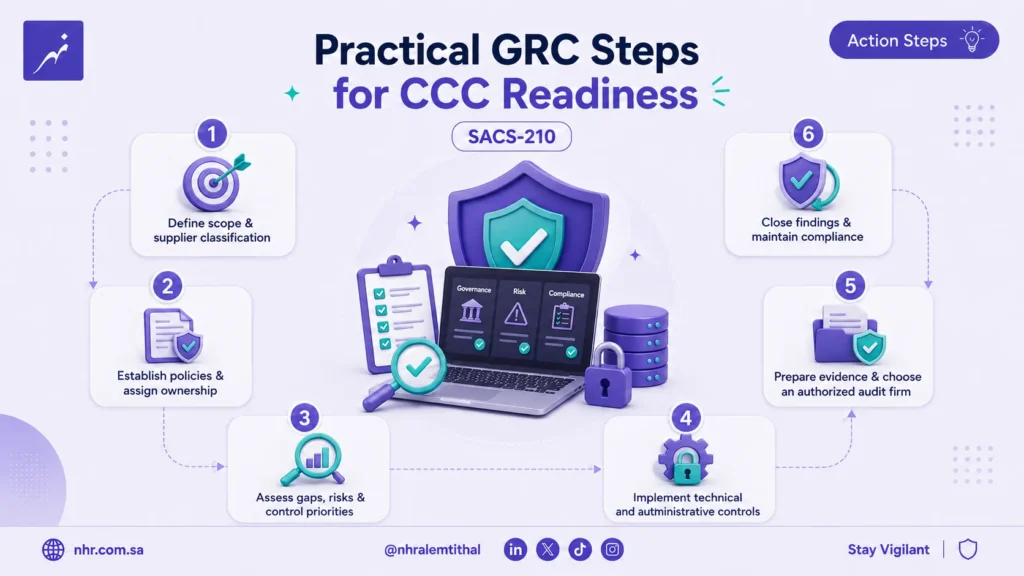
For a small supplier, the following model is usually enough to make the concept practical:
1. Identify the Requirement
Understand what SACS-210 expects.
Do not begin by purchasing tools or creating documents until the requirement itself is clear.
2. Choose the Practical Document or Control
Ask what is needed to make the requirement work in your environment.
It may be:
- a policy;
- a checklist;
- a register;
- a procedure;
- a technical security configuration;
- or a combination of these.
3. Put It Into Use
A policy should be approved and communicated.
A checklist should actually be completed.
A register should be maintained.
A technical control should be configured.
4. Keep Evidence
Retain enough information to show that the activity happened.
This may include:
- completed forms;
- approved documents;
- system exports;
- configuration records;
- screenshots where appropriate;
- inventories;
- review records;
- logs;
- or incident records.
5. Keep It Current
Compliance documentation should reflect the real environment.
If employees, systems, access, services or responsibilities change, the relevant records should change with them.
This is GRC at a scale that makes sense for a small business.
You Do Not Need to Turn Every Requirement Into Paperwork
SACS-210 General Requirements contain both administrative and technical expectations.
A small supplier should not try to create a policy or procedure for every line of the standard when another form of implementation is more appropriate.
For example:
- MFA is primarily a technical control.
- SPF, DKIM and DMARC require technical email configuration.
- endpoint firewalls require configuration.
- anti-malware protection requires implementation and maintenance.
- logging requires systems to generate and protect the required events.
The supporting documentation should help explain or evidence those controls.
It should not replace them.
For detailed IT implementation guidance, use the SACS-210 Technical Implementation Checklist.
This keeps responsibilities practical:
Business documentation supports the requirement.
Technical configuration implements the technical control.
Evidence demonstrates what was actually done.
Five Common GRC Mistakes Small Suppliers Should Avoid
1. Assuming everything belongs to IT
Many General Requirements involve management, HR/Admin and business operations as well as IT.
IT can configure access controls, but it may not be the right function to approve every policy or manage every employee record.
2. Buying technology before understanding the requirement
A security product can support a requirement, but purchasing software does not automatically satisfy SACS-210.
Understand the objective first.
Then select the appropriate implementation.
3. Downloading templates and never adapting them
Generic templates may describe people, systems or processes that do not exist in your organization.
Customize documents so they reflect your real environment.
4. Performing the activity but keeping no record
A small business may genuinely remove access, return equipment or review accounts but keep no organized evidence.
Simple checklists, registers and review records can solve this problem without creating unnecessary bureaucracy.
5. Waiting until the audit is close
Trying to reconstruct months of records shortly before formal verification is much harder than keeping them as part of normal operations.
Build documentation and evidence while the controls are being implemented.
What Should a Small Supplier Do Next?
Your next step depends on where you are today.
You are not sure where your business stands
Start with the SACS-210 Self-Assessment for a preliminary view of the General Requirements.
You want a structured preliminary gap review
Use the SACS-210 Gap Assessment Guide.
Your IT team or MSP is implementing technical controls
Use the SACS-210 Technical Implementation Checklist.
Your existing environment has gaps that need remediation
Review NHR Alemtithal’s CCC Implementation Service.
You are preparing for formal verification
Read the Aramco CCC Audit Readiness Guide.
You need to understand the formal audit stage
See the Aramco CCC Authorized Audit Firms Guide.
For the broader certificate process, requirements and CCC context, use the Aramco CCC Certification Guide.
Frequently Asked Questions
Is GRC a separate requirement in SACS-210?
No. In this guide, GRC is a practical management lens used to organize governance, risk and compliance activities across the SACS-210 General Requirements. It is not a separate certificate, classification or control family.
Does a small supplier need a dedicated GRC department?
Not necessarily. Small businesses can distribute the required activities across existing management, administration, IT staff, an MSP or external specialists. What matters is that the applicable requirements are implemented and supported by appropriate documentation and evidence.
Do I need GRC software for SACS-210 General Requirements?
Not simply because you are using a GRC approach. A small business can organize many activities using practical policies, forms, registers, checklists and controlled document storage. The appropriate tools depend on the size and complexity of the environment.
Can templates help with SACS-210 preparation?
Yes. Templates can significantly reduce the effort required to build common policies, forms and registers from scratch. They must still be customized to the actual business, approved where required and used in practice.
Does having the correct documents mean the business is compliant?
No. Documentation is one part of readiness. The documented activities and technical controls also need to be implemented, and suitable evidence should be retained.
Does this guide cover SACS-210 Specific Requirements?
No. This article focuses on the General Requirements TPC1.1–TPC1.33. Additional Specific Requirements may apply depending on the Third Party’s classification, services, access and other factors.
Final Takeaway
GRC for a small Saudi Aramco supplier should not become an enterprise bureaucracy exercise.
The practical objective is simpler:
Understand the requirement.
Use the right policy, procedure, checklist or technical control.
Put it into practice.
Keep the evidence.
Well-structured documentation can make that process significantly easier, especially for a small business with limited internal resources.
But the strongest compliance position comes when the documents, the real operating environment and the technical controls all describe the same reality.
That is where GRC becomes useful—not as another department or software platform, but as a practical way to keep SACS-210 preparation organized and manageable.
Official Reference
Saudi Aramco — Third-Party Cybersecurity Standard SACS-210, February 2026
NHR Alemtithal resource copy:
Disclaimer: NHR Alemtithal is an independent Saudi cybersecurity and IT services provider that supports organizations with cybersecurity implementation, documentation and audit preparation. NHR Alemtithal is not Saudi Aramco and does not perform the independent certification audit unless separately authorized to do so. Final certification and applicable requirements depend on the official process and the Third Party’s scope and classification.