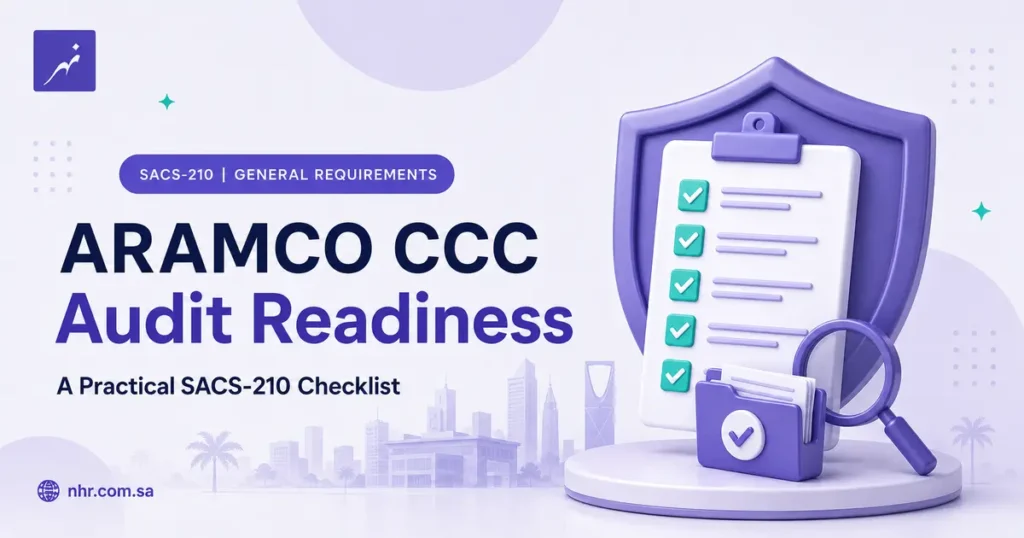
Aramco CCC audit readiness is not the same as reading SACS-210 or answering “Yes” to a checklist. Your organization is ready when the applicable controls are implemented, your policies reflect the real environment, and your evidence is clear enough for an authorized audit firm to verify.
For suppliers preparing under the SACS-210 General Requirements, this means demonstrating alignment with controls TPC1.1 through TPC1.33 through a combination of approved documents, working security configurations, operational records and traceable evidence.
This readiness guide explains how to evaluate your current position before formal verification, identify the gaps most likely to delay the assessment, and choose the right next step. For a broader explanation of certificate types, requirements, validity and the complete process, start with the Aramco CCC Certification Guide.
What Does Aramco CCC Audit Readiness Mean?
Audit readiness means that your organization can support every applicable compliance answer with evidence that reflects what is actually implemented. A policy alone does not prove that a control is operating, and a screenshot alone may not prove that the configuration is approved, maintained or connected to your organization.
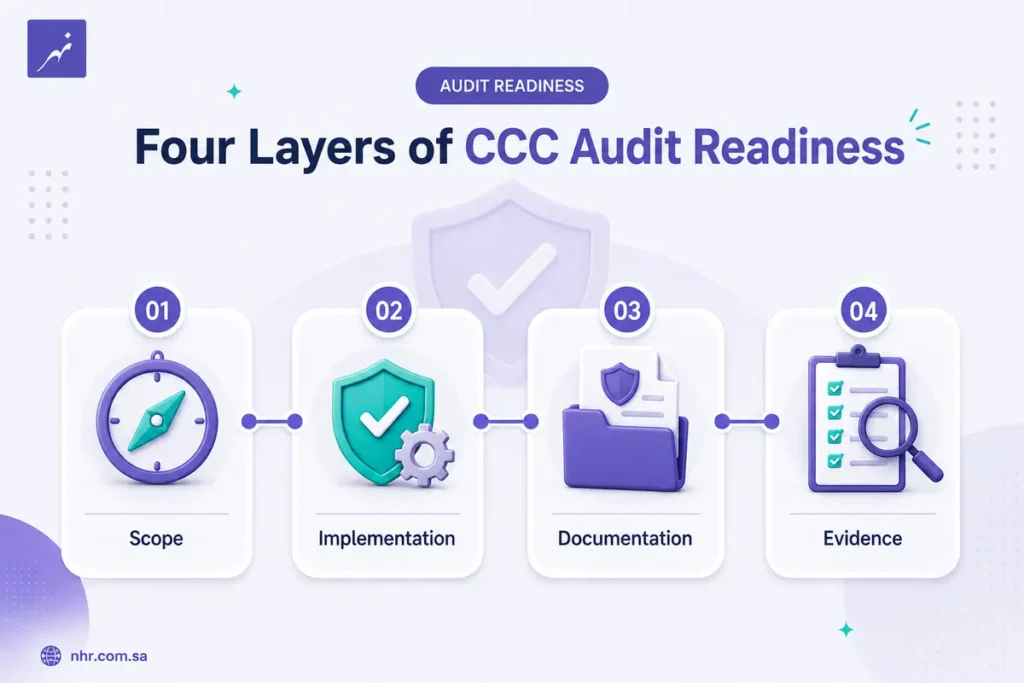
A practical readiness position has four connected layers:
- Scope: You know which SACS-210 requirements and certificate type apply to your organization.
- Implementation: The required administrative and technical controls are operating in your environment.
- Documentation: Policies, procedures, registers and reports accurately describe the implemented environment.
- Evidence: The assessment package contains clear, current and traceable proof for the authorized audit firm.
Readiness principle: the control, the written document and the submitted evidence should tell the same story.
Before You Start: Confirm Your Assessment Scope
Do not begin collecting evidence until you understand the applicable assessment route. Under Aramco’s current CCC program, suppliers in the registration phase start with the General Requirements. Organizations with ongoing Aramco business may have additional requirements based on their Third Party Classification.
Standard CCC generally involves a self-compliance assessment followed by remote verification from an Aramco-authorized audit firm. CCC+ applies to classifications such as Direct Network Connectivity and Critical Data Processor and requires an on-site assessment.
If you are uncertain about the correct route, review the CCC versus CCC+ explanation in our complete guide and confirm the current classification requirements before committing to an audit schedule.
What an Audit-Ready Evidence Package Looks Like
For standard CCC, the organization completes the applicable compliance report and provides supporting evidence. Aramco’s published process emphasizes that submitted evidence should be readable, time-stamped, clearly related to the assessed third party and visibly identified within screenshots.
Approved governance documents
- Policies and procedures approved by the appropriate authority.
- Named owners, review dates and document versions.
- Employee acknowledgements, awareness records and relevant management approvals.
Technical implementation evidence
- Configuration screenshots showing that relevant identity, endpoint, network, email and logging controls are enabled.
- Reports or console views that identify the organization, system or tenant being assessed.
- Current evidence that can be traced to the applicable requirement.
Operational records
- Asset inventories, access reviews, training records and other required registers.
- Logs or reports showing that controls are operating rather than merely configured once.
- Records demonstrating that documented processes are being followed in practice.
Aramco CCC Audit Readiness Checklist
Use the following checklist as a management-level readiness screen. It does not replace the official SACS-210 standard, the current compliance report or an evidence review.
1. Scope and ownership
- The applicable certificate type and assessment scope have been confirmed.
- An internal owner is responsible for coordinating compliance activities and evidence.
- The current SACS-210 standard and compliance-report template are being used.
2. Policies and procedures
- Required policies and procedures are approved, version-controlled and communicated.
- The documents name the technologies and processes actually used by the organization.
- Forms, registers and reports contain real operational records rather than empty templates.
3. Technical controls
- Corporate identities and access rights are centrally controlled.
- Applicable authentication, endpoint, encryption, patching, network and email protections are active.
- Logging and monitoring are enabled for the systems included in the assessment scope.
- Administrative access and everyday user access are appropriately separated and controlled.
4. People and operations
- Employee onboarding, access changes and offboarding are documented.
- Cybersecurity awareness activities and acknowledgements can be demonstrated.
- Incident responsibilities and escalation paths are understood by the relevant personnel.
5. Evidence quality
- Every applicable response can be matched to one or more supporting files.
- Screenshots are readable, current, time-stamped where applicable and clearly tied to the organization.
- File names and folders make it easy for the reviewer to locate evidence by control.
- Someone other than the implementer has reviewed the package for missing or contradictory evidence.
Important: a “Yes” answer is only a preliminary indicator. Audit readiness depends on whether the answer can be verified using suitable evidence.
Common Issues That Delay CCC Verification
Generic policies that do not match the environment
A downloaded policy may look complete but still create contradictions if it refers to systems, roles or processes that the organization does not use. Policies should describe the real operating environment and assign realistic responsibilities.
Controls without operating evidence
A configuration screen can show that a setting exists. It may not demonstrate that reviews, training, monitoring or employee processes have been performed. Operational controls usually require records created over time.
Evidence collected too late
If evidence collection begins only after the technical work is complete, useful timestamps, reports or implementation records may be missing. Build the evidence plan alongside the control implementation.
Unreadable or untraceable screenshots
Cropped screenshots, missing tenant names, unclear dates or files with no control reference create avoidable review cycles. Evidence should make the relationship between the requirement, the organization and the implemented setting easy to understand.
Treating the audit firm as the implementation provider
The authorized audit firm independently verifies compliance and issues the certificate after successful verification. Your organization should prepare the controls, documents and evidence before relying on the formal assessment to discover implementation gaps.
Start With a Preliminary SACS-210 Self-Assessment
If you do not yet know where your largest gaps are, NHR Alemtithal provides a free preliminary questionnaire covering the 33 SACS-210 General Requirements controls.
- 33 targeted questions: one initial assessment point for each General Requirements control.
- Simple response options: identify controls that appear implemented, missing or uncertain.
- Automated email report: after submission, Power Automate generates the report and sends it to the email address provided in the form.
- Control-level findings: the report shows the status recorded for TPC1.1–TPC1.33 and provides the associated risk and high-level remediation guidance where a potential gap is identified.
The questionnaire normally takes approximately 5–10 minutes and does not require evidence uploads. Because the result is based on self-reported answers, it is a starting point—not confirmation that a control will pass formal verification.
Assessment limitation: this is an independent preliminary tool from NHR Alemtithal. It is not endorsed by Saudi Aramco, does not validate supporting evidence and does not replace verification by an Aramco-authorized audit firm.
Questionnaire, Gap Assessment or Formal Audit?
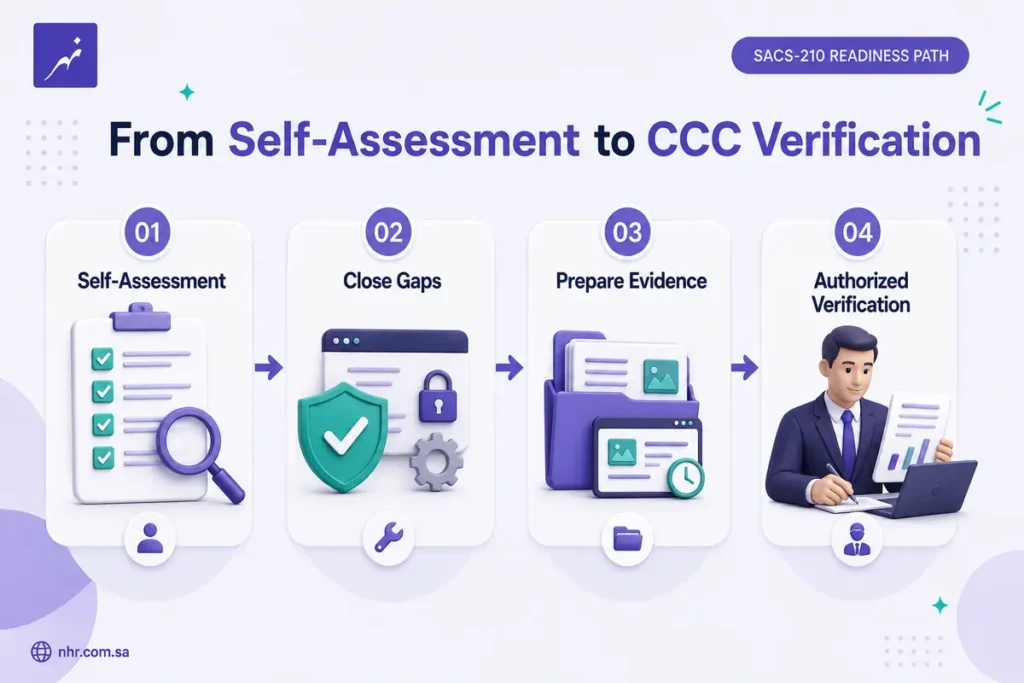
| Stage | Primary purpose | Output |
|---|---|---|
| Self-assessment questionnaire | Quickly identify likely gaps or uncertain controls | Automated preliminary report based on your answers |
| Gap assessment resource | Review requirements in more detail and plan practical actions | Working checklist and implementation guidance |
| Professional readiness assessment | Validate controls, documents and evidence before formal verification | Confirmed gaps and a tailored remediation plan |
| Authorized audit verification | Perform the official compliance verification for the applicable CCC route | Compliance report and certificate after successful verification |
For a practical control-by-control planning resource, use the SACS-210 SME Gap Assessment and Free Tools Guide. It is designed for organizations that want to move from an initial result to a more structured remediation plan.
When Should You Engage an Authorized Audit Firm?
You may contact an authorized audit firm early to understand commercial terms and scheduling. Formal verification is more efficient, however, when the applicable controls are implemented, the compliance report is complete and the supporting evidence has already been reviewed for quality and consistency.
Always verify the current firms directly through Aramco’s CCC program before signing an engagement. You can also use NHR’s Aramco CCC Authorized Audit Firms resource as a convenient reference, while treating Aramco’s current published list as authoritative.
Choose the Right Remediation Path
The right implementation approach depends on what your organization already has.
- Starting from zero: If you are a first-time applicant and need a new, isolated General Requirements environment, review the NHR Aramco CCC Turnkey Kit.
- Using an existing environment: If you already have devices, identity, email, network and security systems, use the CCC Implementation service to assess and remediate the current environment.
In both cases, the objective is the same: implement the applicable controls, make the documentation reflect reality and prepare evidence that an independent authorized audit firm can verify.
Frequently Asked Questions
Is the NHR SACS-210 self-assessment an official Aramco assessment?
No. It is an independent preliminary tool developed by NHR Alemtithal to help organizations identify likely gaps. Official CCC verification must be performed through an audit firm authorized by Saudi Aramco.
Does a positive self-assessment result mean we are audit-ready?
Not by itself. The questionnaire is based on your responses and does not inspect configurations or validate uploaded evidence. Audit readiness also requires suitable documentation, operational records and clear evidence for each applicable control.
How quickly will I receive the assessment report?
The report is generated automatically through Microsoft Forms and Power Automate after you submit the questionnaire, then sent to the email address you provided. Email delivery time may vary slightly depending on the receiving mail system.
What does the automated report include?
It covers TPC1.1 through TPC1.33 and records an initial status for each control. Where your answer indicates a potential gap, the report includes the related risk and high-level recommended remediation actions.
What evidence is usually needed for CCC verification?
The evidence depends on the control and assessment scope. It may include approved policies, registers, configuration screenshots, system reports, logs, training records and evidence of operational processes. Submitted evidence should be readable, current and clearly connected to the organization being assessed.
Should we contact an authorized audit firm before closing every gap?
You can contact a firm early for quotations and scheduling, but formal verification is usually more efficient after the applicable controls, documentation and evidence package have been prepared and reviewed.
Disclaimer: This article and the NHR self-assessment are independent readiness resources and are not official Saudi Aramco publications. Saudi Aramco’s current SACS-210 standard, CCC program instructions, classification requirements and authorized-auditor information remain the authoritative sources. NHR Alemtithal provides implementation and compliance support; the independent authorized audit firm performs the formal verification and issues the certificate after successful assessment.
Need help with Aramco CCC Certification?
Get a Free Expert Consultation.

Ali Aljubaily
Saudi cybersecurity and IT leader with 20+ years of experience building security programs from scratch for Saudi SMEs and enterprise groups. Specialized in Aramco Third Party Cybersecurity Standard (CCC), NCA ECC compliance, and implementing technical security controls for organizations in construction, energy, and trading sectors.