For a Saudi SME preparing for Aramco Cybersecurity Compliance Certificate (CCC), the immediate objective is clear: build the environment, documentation, and evidence needed for the applicable SACS-210 assessment.
But for a business owner, general manager, procurement lead, or IT administrator, there is another practical question:
After the CCC project is complete, what does the company actually keep?
The practical Aramco CCC Kit ROI comes from what the business continues to own, operate, and maintain after the project—not only from reaching the certification milestone.
The Kit is designed for suitable first-time applicants that need a new, dedicated CCC environment. Instead of treating certification as a one-time exercise, the business can look at what remains after the assessment: technical assets, a company-controlled domain, configured services, documentation, evidence, training, and administrative ownership.
The current SACS-210 Third-Party Cybersecurity Standard, February 2026 contains 33 General Requirements, with additional Specific Requirements potentially applying depending on the supplier’s classification and scope. The applicable requirements should always be confirmed against the current standard and assessment scope.
For the current source, see the SACS-210 Third-Party Cybersecurity Standard.
The Certificate Is the Immediate Goal — But What Does Your Company Keep?
The CCC certificate is the immediate business objective.
The Kit is the investment that supports the journey to that objective.
For a small company without a dedicated cybersecurity or GRC department, preparing for CCC can otherwise involve several separate activities: sourcing equipment, configuring cloud services, setting up a private domain and corporate email, implementing security controls, preparing policies, collecting evidence, arranging training, and coordinating the independent assessment.
The CCC Kit brings these elements into one defined implementation scope.
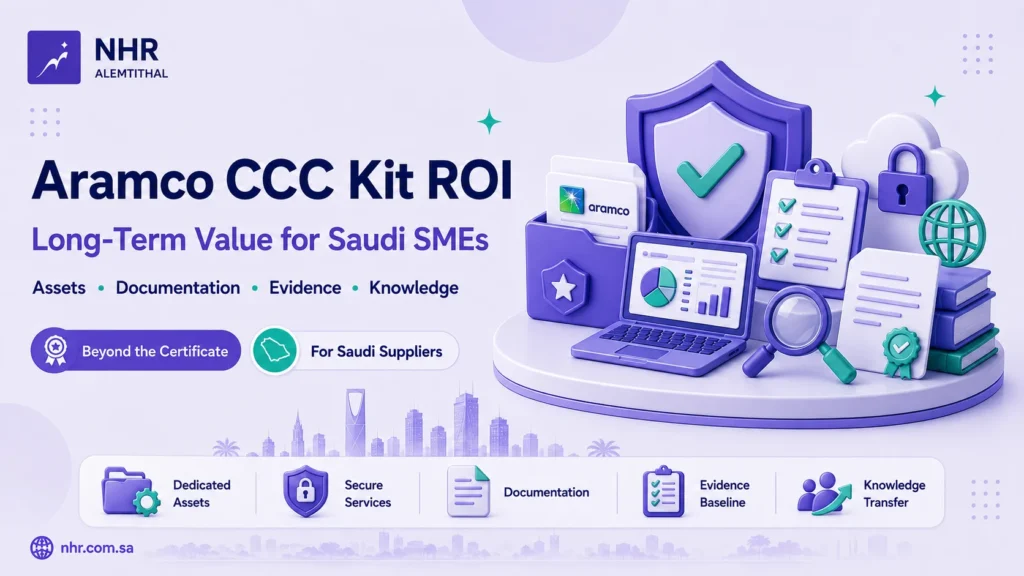
Depending on the agreed scope, the delivered environment includes items such as hardened laptops, a private company domain, secure identity and email, the core compliance documentation set, awareness training, configuration evidence, and assessment coordination.
The certificate represents a milestone.
The environment, assets, documentation, and knowledge delivered through the project can remain with the business after that milestone.
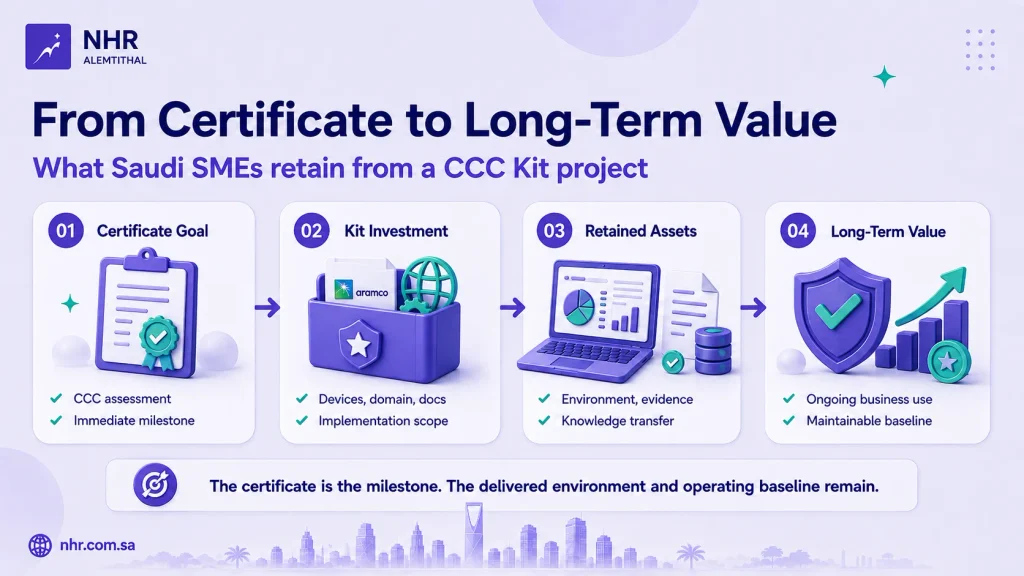
What Stays With Your Business After the CCC Project?
For a Saudi SME, this is one of the simplest ways to understand the long-term value of the Kit.
| What the Kit delivers | Immediate CCC purpose | Value retained by the business |
|---|---|---|
| Hardened laptops | Controlled technical baseline | Company-owned dedicated compliance assets |
| Private company domain | Corporate email requirement | Company-controlled domain |
| Secure identity and email | Access and email security controls | Operable cloud environment |
| Core compliance documents | Governance and assessment evidence | Reusable policy and process baseline |
| Configuration documentation | Demonstrate implementation | Technical maintenance and handover reference |
| Security awareness training | Awareness and evidence | Knowledge retained by staff |
| Evidence package | Assessment readiness | Starting baseline for later reviews |
The important point is that retained value still requires maintenance.
A configured environment can drift. Employees change. Accounts change. Subscriptions expire. Policies become outdated. Evidence loses value if it no longer represents the real configuration.
The Kit therefore creates a starting point that the company must continue to manage—not a permanent compliance state that requires no further work.
1. Fewer Vendors and Less Coordination
Small Saudi businesses rarely have separate internal teams for cybersecurity, cloud identity, endpoint management, governance, procurement, and audit preparation.
Sometimes one IT administrator is handling most of these responsibilities. In other cases, IT is partly outsourced.
A fragmented CCC project can therefore require management to coordinate several suppliers for hardware, cloud services, security configuration, documentation, training, and assessment preparation.
The value of an integrated Kit is not a claim that every company will save a specific percentage of money.
The practical value is simpler:
fewer parties, dependencies, and handoffs for the business to coordinate.
For a small company, reducing administrative complexity can make the project easier to understand and manage.
2. A More Predictable Project Budget
Another challenge for SMEs is uncertainty.
If hardware, licenses, domain services, implementation, documentation, training, and assessment support are sourced independently, management may not have a clear picture of the total project scope at the beginning.
The CCC Kit uses a bundled commercial model with a defined scope. This helps the company understand what is included before implementation starts and can make budgeting and procurement more predictable.
This article intentionally does not include a fixed package price.
Pricing, included commercial items, subscription periods, and terms can change over time. The CCC Kit 2026 service page should remain the source of truth for current pricing and commercial scope.
3. A Dedicated CCC Environment Without Rebuilding Your Entire IT
This is one of the most important advantages—and boundaries—of the current CCC Kit.
The Kit is designed around a new, isolated compliance environment when that model is appropriate for the applicant.
For a first-time SME, this can avoid the complexity of rebuilding the entire production IT environment solely to establish a controlled environment for the applicable SACS-210 General Requirements.
The dedicated laptops, identity, email, domain, and supporting controls can be configured as a defined baseline without requiring every existing workstation, mailbox, server, or production application to be redesigned.
But the boundary must be clear:
The CCC Kit does not automatically secure or remediate the company’s entire production infrastructure.
If existing laptops, an existing Microsoft 365 tenant, current mailboxes, servers, network systems, or the company’s existing domain must remain in scope, a remediation-led project may be more appropriate.
In that situation, review the Aramco CCC Implementation Service.
4. Security, Documentation, and Knowledge Continue After CCC
The security capabilities implemented in the dedicated environment do not stop functioning when the assessment finishes.
Controls such as MFA, corporate email security, endpoint protection, patching, and logging can continue operating within the environment in which they were configured.
The same principle applies to documentation.
Policies, registers, access records, employee procedures, and other compliance documents should not become a folder that is opened only when an auditor asks for evidence.
When maintained properly, they can provide the company with a practical operating baseline.
The handover is also important.
Administrative access, configuration documentation, domain ownership or administration, credentials, and operating guidance help ensure that the business understands what has been delivered and can continue managing it after the implementation project.
For an SME with limited internal cybersecurity resources, this transfer of knowledge and ownership is an important part of the value.
5. Documents and Evidence You Do Not Have to Rebuild from Zero
A future review or recertification does not mean that old documents and screenshots should simply be submitted again.
Evidence must continue to represent the actual environment.
However, maintaining an existing baseline is different from rebuilding one from nothing.
A useful model is:
Configuration → Evidence → Document → Owner
The configuration shows what is implemented.
The evidence demonstrates it.
The document explains the requirement or process.
The owner identifies who is responsible for keeping it current.
Maintaining that structure can reduce the effort required to rediscover the environment and reconstruct documentation later.
For more detail on preparing evidence and validating implementation before assessment, see the Aramco CCC Audit Readiness Guide.
This does not guarantee future recertification or replace independent verification. It provides a maintained starting point.
What the CCC Kit Does — and Does Not — Cover
The strongest business case for the CCC Kit comes from evaluating it against the scope it actually delivers.
For a suitable first-time applicant, it is designed to create a dedicated environment for the applicable SACS-210 General Requirements.
It should not be interpreted to mean that:
- every existing production system in the company has been secured;
- every cybersecurity framework is automatically covered;
- a future CCC assessment will automatically pass;
- obtaining CCC guarantees an Aramco contract or vendor award;
- cyber incidents become impossible after implementation.
Those are different claims and should not be attached to the product.
The Kit should be evaluated against the scope it actually delivers—not against promises outside that scope.
This distinction is especially important for a small business deciding whether the Kit or remediation of its existing environment is the better route.
So Where Does the Long-Term Aramco CCC Kit ROI Come From?
For a Saudi SME with limited internal IT or cybersecurity resources, long-term ROI is not best understood as a theoretical financial formula.
It is the retained value of what the project leaves behind.
That can include:
- fewer fragmented procurement activities;
- a clearer implementation scope;
- more predictable project planning;
- dedicated company-owned technical assets;
- a company-controlled domain;
- an operable identity and email environment;
- reusable compliance documentation;
- a maintainable evidence baseline;
- staff training and operating knowledge;
- administrative and configuration handover.
None of these guarantees a specific financial return.
Together, however, they explain why the business should not view the CCC Kit only as an expense required to reach an assessment date.
The company is investing in both the immediate CCC objective and the environment, assets, documentation, and knowledge that remain afterwards.
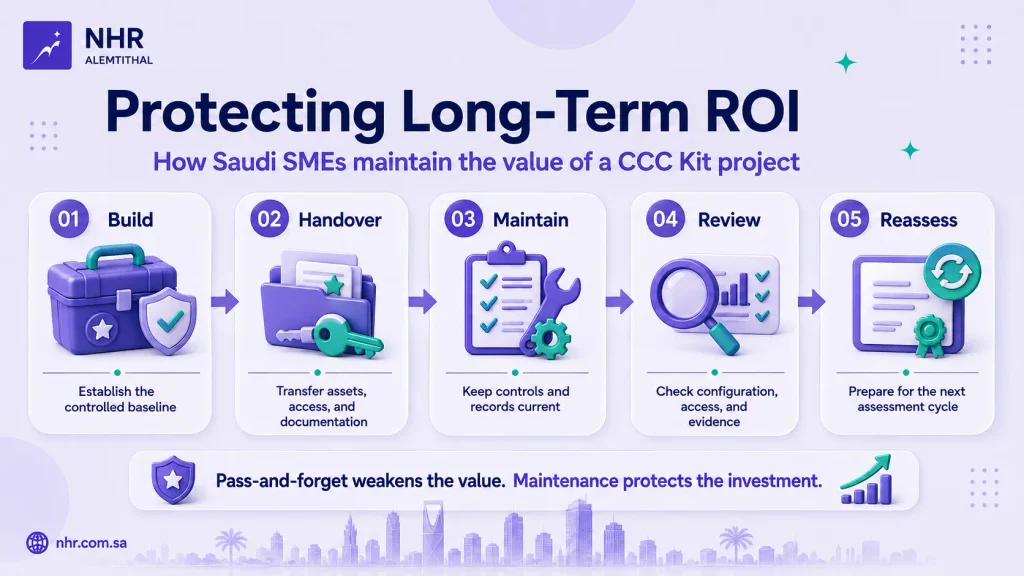
How to Protect That Investment After Certification
Long-term value depends on what happens after the project.
Keep the hardened devices within their intended use. Maintain the domain and required subscriptions. Review user access when personnel change. Keep security configurations controlled and documented. Update policies and registers when the environment changes, and retain evidence that still represents the actual implementation.
The practical lifecycle is:
Build → Handover → Maintain → Review → Reassess
A pass-and-forget approach gradually weakens the baseline that the company paid to create.
Conclusion
The immediate purpose of the Aramco CCC Kit 2026 is to help a suitable Saudi SME establish a dedicated environment for the applicable SACS-210 General Requirements assessment.
Its longer-term value is what remains after that milestone: technical assets, a controlled company domain, configured services, documentation, evidence, staff knowledge, and an operating baseline that the company can continue to maintain.
That is the practical ROI beyond the certificate.
If your company is a first-time applicant that needs a new, isolated CCC environment, explore the Aramco Cybersecurity Compliance Certificate (CCC) Kit 2026.
If you already have devices, mailboxes, a domain, cloud services, or production infrastructure that must remain in scope, review the Aramco CCC Implementation Service instead.
Disclaimer: This article explains the intended business value and scope of NHR Alemtithal’s CCC Kit. It is not a Saudi Aramco publication and does not replace the current SACS-210 standard, the applicable classification process, technical assessment, or independent verification by an authorized audit firm. Certification depends on the applicable scope, implemented controls, supporting evidence, and the official assessment process.
Need help with Aramco CCC Certification?
Get a Free Expert Consultation.