You lock your office doors at night. You have passwords on your computers. But are you leaving your most valuable asset—your brand’s reputation—completely unprotected online?
If you haven’t configured DMARC for your business email, the answer is likely yes. Every day, cybercriminals send billions of phishing emails, many of them by “spoofing” or impersonating legitimate businesses just like yours. They use your trusted name to trick your customers, partners, and even your own employees into clicking malicious links, wiring funds, or giving up sensitive data.
The primary defense against this is DMARC.
What Exactly is DMARC?
DMARC stands for Domain-based Message Authentication, Reporting, and Conformance. In simple terms, it’s a set of rules you publish for your email domain that works with receiving email systems around the world. It acts as an instruction manual, telling servers like Gmail, Outlook, and Yahoo what to do with an email that claims to be from you but doesn’t pass authentication checks.
Think of it like a bouncer for your brand’s email. It checks the ID of every message that shows up wearing your domain’s logo.
How DMARC Works: The Three Musketeers of Email Security
DMARC doesn’t work alone. It relies on two other email authentication standards:
- SPF (Sender Policy Framework): This is a public list of all the servers and services (like Microsoft 365, Mailchimp, etc.) that are officially allowed to send email on your behalf.
- DKIM (DomainKeys Identified Mail): This adds a unique, tamper-proof digital signature to your outgoing emails. If the email is altered in transit, the signature breaks, and the email is flagged as suspicious.
DMARC is the final piece of the puzzle. It tells the receiving server: “If an email says it’s from me, but it fails either the SPF or DKIM check, here is what you should do with it.”
Why You Need DMARC Right Now
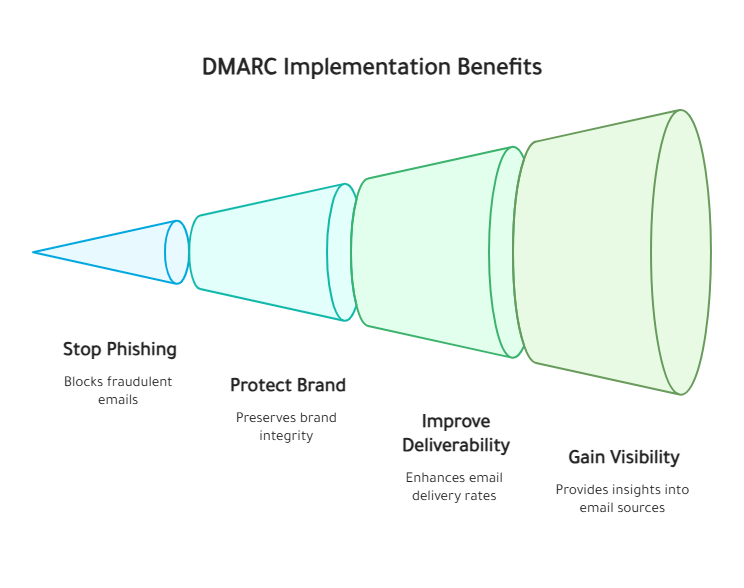
- To Stop Phishing and Spoofing: This is the most critical reason. A properly configured DMARC policy can eventually be set to p=reject, which instructs receiving servers to block any fraudulent email sent on your behalf. This makes your domain a hardened, unattractive target for criminals.
- To Protect Your Brand Reputation: Every time a fraudulent email is sent using your domain, it erodes trust in your brand. DMARC ensures that only legitimate emails reach your audience, preserving the integrity and reputation you’ve worked so hard to build.
- To Improve Email Deliverability: Major email providers like Google and Yahoo give preferential treatment to emails that are properly authenticated. Implementing DMARC signals that you are a responsible sender, which increases the likelihood that your marketing and transactional emails will land in the inbox, not the spam folder.
- To Gain Visibility: DMARC provides reports that give you incredible insight into who is sending email from your domain—both the good and the bad. This helps you identify all your legitimate sending sources and uncover potential security gaps.
Getting Started with DMARC
While the concept is straightforward, implementing DMARC can be complex. A mistake in your SPF record or a misconfiguration of DKIM can lead to your legitimate emails being blocked.
That’s why we created our Domain Shield service. For a simple, one-time fee, our experts will handle the entire setup for you, configuring your SPF, DKIM, and DMARC records according to best practices. We take the guesswork out of email security so you can focus on your business.
Don’t leave your front door open for cybercriminals. Secure your email domain today.